 Hyperliquid
 funding rates determine who pays at hourly settlement
Updated on
Hyperliquid funding rates determine hourly payments between traders holding long and short perpetual positions. Positive funding means longs pay shorts; negative funding reverses that direction. The payment depends on the position size, the applicable oracle price, and the settled rate. A displayed percentage therefore needs both a time basis and a position value to explain the account charge.
Funding changes the cost of holding an open position. Understanding that cost requires separating the rate estimate from the settled payment, and separating the value of the position from the collateral supporting it.
Hourly settlement and open exposure
Perpetual contracts have no scheduled expiration, and their funding payments recur hourly while exposure remains open. A resting order does not itself establish a position. Its executed quantity determines whether it opens, increases, reduces, or closes exposure before settlement.
A submitted closing order therefore does not prove that funding exposure has ended. An unfilled or partially filled order can leave a position open across the settlement boundary. Order types affect execution conditions; the remaining position determines the exposure that continues.
Position value and collateral requirements
The funding amount depends on exposure, while leverage determines how much initial margin supports that exposure.
The funding payment equals position size multiplied by oracle price and the applicable hourly funding rate. Use the absolute values of both position size and funding rate to calculate payment magnitude, then use position direction and the rate sign to identify the payer.
Changing the leverage setting without changing position size does not add another multiplier to this formula. It changes the initial margin requirement. Consequently, the same funding amount can represent a larger share of the collateral supporting a more highly leveraged position.
Margin calculations use mark price, and liquidation depends on the applicable maintenance requirement. Cross margin shares collateral within the scope of the account configuration; isolated margin confines support to the individual position. A funding debit can reduce the buffer available against losses, even when the position quantity remains unchanged.
How does the premium affect the funding rate?
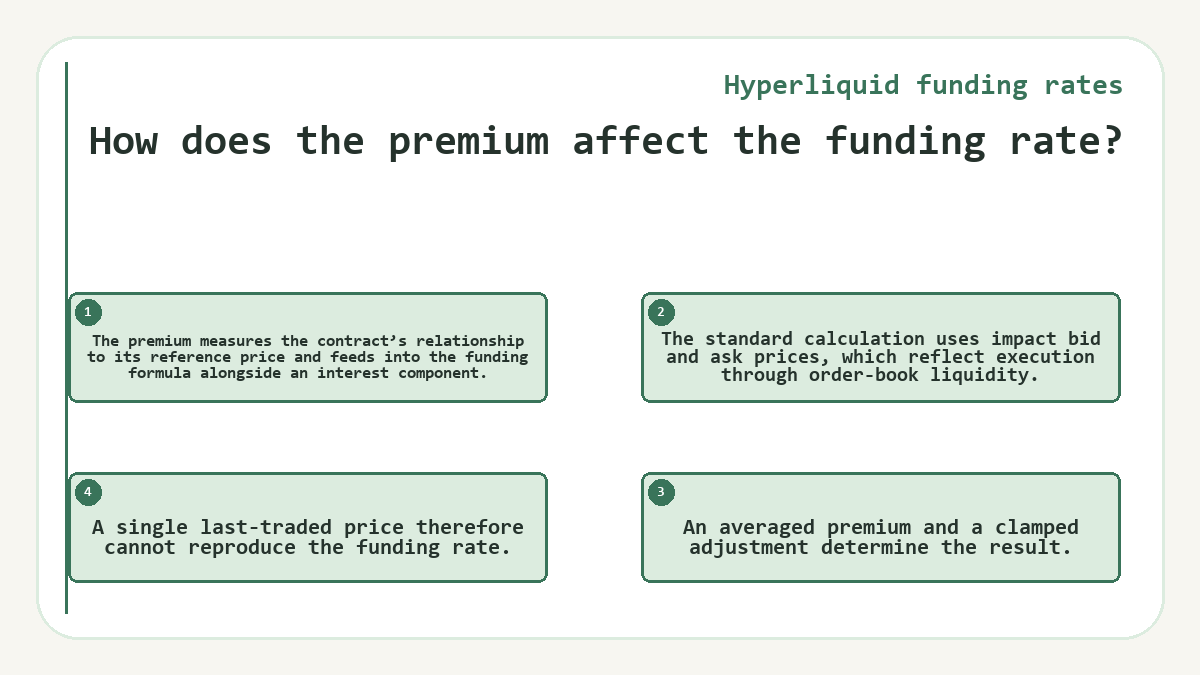
The premium measures the contract’s relationship to its reference price and feeds into the funding formula alongside an interest component. The standard calculation uses impact bid and ask prices, which reflect execution through order-book liquidity. An averaged premium and a clamped adjustment determine the result. A single last-traded price therefore cannot reproduce the funding rate.
Estimates, settled rates, and account entries
Market funding history records rates, while account funding history records the transfers attributable to a particular account. An estimate describes an anticipated rate; a settled account entry establishes an actual debit or credit.
The API separates current asset context, historical funding rates, and user funding history. Account funding entries include the market, timestamp, rate, signed position size, and payment amount. These fields allow a payment to be matched to its settlement interval without treating every balance change as funding. Deposits, transfers, and withdrawals have separate ledger records.
Mark price also affects unrealized profit and loss. A changing account value can therefore reflect price movement as well as funding. Oracle price supplies the funding valuation input, whereas mark price serves margin and unrealized-profit calculations.
Position checks before and after funding settlement
An unidentified rate interval prevents a meaningful cost estimate. For a position that may remain open, establish that interval before using the displayed percentage to decide whether to retain or reduce exposure.
- If the display does not identify its interval, resolve the time basis before calculating a payment.
- If the rate is an estimate, leave room for a different settled value.
- If the position quantity has changed, use the remaining exposure rather than the original order size.
- If reducing exposure requires an order, inspect its fills and remaining position before assuming the reduction occurred.
- After settlement, match the funding entry to the account, market, and timestamp.
A completed reduction changes subsequent exposure. A funding entry confirms the transfer for its recorded interval; it does not establish the next payment.
Contract-specific funding inputs
Contract identity matters when interpreting apparently similar funding displays. Hyperliquid supports mechanisms with different reference-price and configuration inputs.
Standard crypto perpetuals use an underlying oracle reference. Hyperps instead use a moving average of their own mark prices in place of the usual external spot reference. Their funding behavior therefore cannot be interpreted solely as a gap against a separately traded spot asset.
Builder-deployed perpetuals under HIP-3 have deployer-defined contract specifications and oracle arrangements. The deployer determines the market definition and operates its oracle updates. A shared underlying label does not establish identical reference inputs across these contracts.
HIP-3 funding also supports configurable multipliers, and its premium calculation differs from the standard formula. Those settings can change how a price difference translates into funding. Apply the selected contract’s parameters when interpreting its rate instead of assuming one configuration covers every market.
Holding-cost estimates across multiple settlements
A holding-cost estimate must match the rate’s quoted interval. Hyperliquid’s standard formula uses an eight-hour basis, while each hourly payment uses one eighth of the rate computed for that hour. An hourly display already reflects that shorter interval.
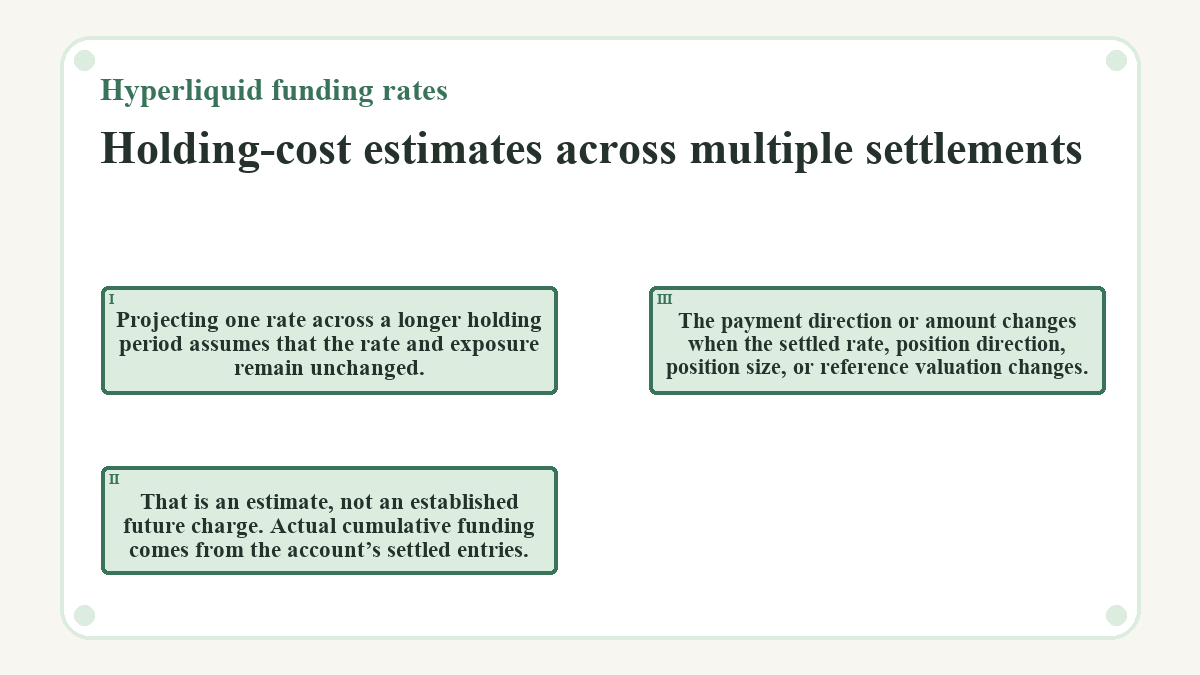
Projecting one rate across a longer holding period assumes that the rate and exposure remain unchanged. That is an estimate, not an established future charge. Actual cumulative funding comes from the account’s settled entries. The payment direction or amount changes when the settled rate, position direction, position size, or reference valuation changes.
What to know about Hyperliquid funding rates
Does Hyperliquid collect a commission on funding transfers?
Hyperliquid does not collect a fee on the funding payments exchanged between position holders. Trading fees concern execution and remain a separate cost. Receiving funding therefore does not mean that opening and closing the position is free.
Can positive funding guarantee a profitable short position?
Positive funding cannot guarantee that a short position earns an overall profit. An adverse price move can outweigh the funding received, and margin requirements still apply. Funding income and unrealized trading profit are separate components of the account outcome.
Which API request retrieves an account’s funding payments?
The userFunding request retrieves funding entries for the specified account and time range. The fundingHistory request instead retrieves historical rates for a market. Use the account record when the question concerns an actual payment, because a market rate alone does not establish that account’s exposure.
Are predicted funding rates available for every Hyperliquid perpetual DEX?
The predictedFundings API request supports the first perpetual DEX, rather than every builder-deployed DEX. An unavailable prediction does not establish a zero funding rate. Current asset context and historical funding data are separate request types with their own market-selection requirements.
Will adding isolated margin reduce the next funding payment?
Adding isolated margin does not reduce funding when position size, reference price, and the applicable rate remain unchanged. It changes the collateral supporting the position. Its purpose in this context is to increase the margin buffer, subject to the contract’s rules, rather than to reduce the exposure used in funding calculations.